

The healthcare industry is in the midst of an IT revolution — driven by the need to enhance patient outcomes, increase patient engagement, and reduce costs. A major indicator of this shift is the widespread adoption of technology, with over 95% of hospitals in the USA now utilizing certified Electronic Health Record (EHR) systems.
An essential aspect of this transformation is SMART on FHIR, which significantly improves data interoperability, security, and user experience across EHR systems and apps. This initiative facilitates better communication between healthcare providers and streamlines patient care management.
But what does SMART on FHIR stand for, and how else does it impact healthcare app development? Read on to find out.
What is FHIR and Why Does It Matter in Healthcare?
FHIR (Fast Healthcare Interoperability Resources) is a standard Health Level Seven International (HL7) developed to enable the electronic exchange of healthcare information. It specifies how data may be exchanged and used across several platforms, making it easier for healthcare practitioners to access and share patient information.
The importance of FHIR in healthcare cannot be overstated. It supports various applications, including monitoring chronic illnesses, managing care plans, and sharing information with healthcare systems, providers, caregivers, and family members. It enhances patient control over their records, allowing them to set up alerts for updates to their care plans. Patients do not need to provide their medical history when visiting a new doctor; all information is readily accessible in the database.
As of 2022, over 66% of hospitals were already using an HL7® FHIR® API to provide patient access to data, underscoring its widespread adoption and critical role in advancing healthcare interoperability.
What is SMART and How Does It Work with FHIR?
As discussed, FHIR is a standardized format for exchanging healthcare data. It’s like a common language that different EHR systems can understand. Now, SMART (Substitutable Medical Applications & Reusable Technologies) is a set of specifications that allows developers to create apps that can securely access and share EHR data.
SMART on FHIR combines these two technologies to improve healthcare apps’ interactions with EHRs.
SMART provides several enhancements to FHIR:
- SMART on FHIR uses standardized protocols, making it easier for apps to work across different healthcare systems.
- It allows for seamless interoperability between diverse systems, improving the flow of healthcare information.
- Developers can build reusable apps that can be deployed on many different platforms, lowering development time and costs.
- By enabling access to comprehensive patient data, SMART on FHIR apps can support more personalized and effective care.
Use Cases of SMART on FHIR Apps
The SMART on FHIR framework has revolutionized digital health innovation, providing a standardized method for apps to connect with EHR systems securely. It enables healthcare vendors and providers to exchange patient data instantly while maintaining security and interoperability.
Real-world smart on FHIR examples demonstrate how this standard is applied to improve patient outcomes, clinical efficiency, and decision-making across different care settings.
1. Patient-Facing Applications
Patient engagement apps built on SMART on FHIR allow users to access medical records, medication lists, and lab results directly from their smartphones. These applications empower patients to take ownership of their care and communicate efficiently with providers.
2. Clinical Decision Support Tools
Hospitals and clinics are using SMART on FHIR-enabled applications that overlay predictive analytics on top of EHR data. Such apps assist clinicians in diagnosing conditions, adjusting treatments, and monitoring outcomes in real time — an essential component of build advanced healthcare solutions.
3. Telehealth and Remote Monitoring
Integrating wearable data into a clinical system is another growing use case. Apps can retrieve data, such as blood pressure, glucose levels, and heart rate, from connected devices, providing physicians with real-time insights and enabling proactive interventions.
4. Population Health Management
Public health organizations leverage SMART on FHIR apps to analyze large datasets, track disease trends, and manage preventive care campaigns. By centralizing structured health information, these tools enable population-level insights to be made actionable.
The adaptability of SMART on FHIR supports everything from startup innovation to enterprise-scale health management, making it one of the most impactful standards in modern healthcare technology.
The Synergy of SMART on FHIR
FHIR was designed to enable the smooth flow of health data. However, getting apps to leverage this data treasure trove was challenging. This is where SMART on FHIR comes in. It is the secure link between FHIR’s data and healthcare apps and grants authorized applications access to patient data stored in existing FHIR-enabled EHRs.
SMART also ensures a consistent user experience across all EHRs, eliminating the need for developers to create interfaces for each system. This synergy of SMART on FHIR ushers in a new era of healthcare app development, where developers can concentrate on creative features and functionality.
Benefits of SMART on FHIR for Healthcare App Development
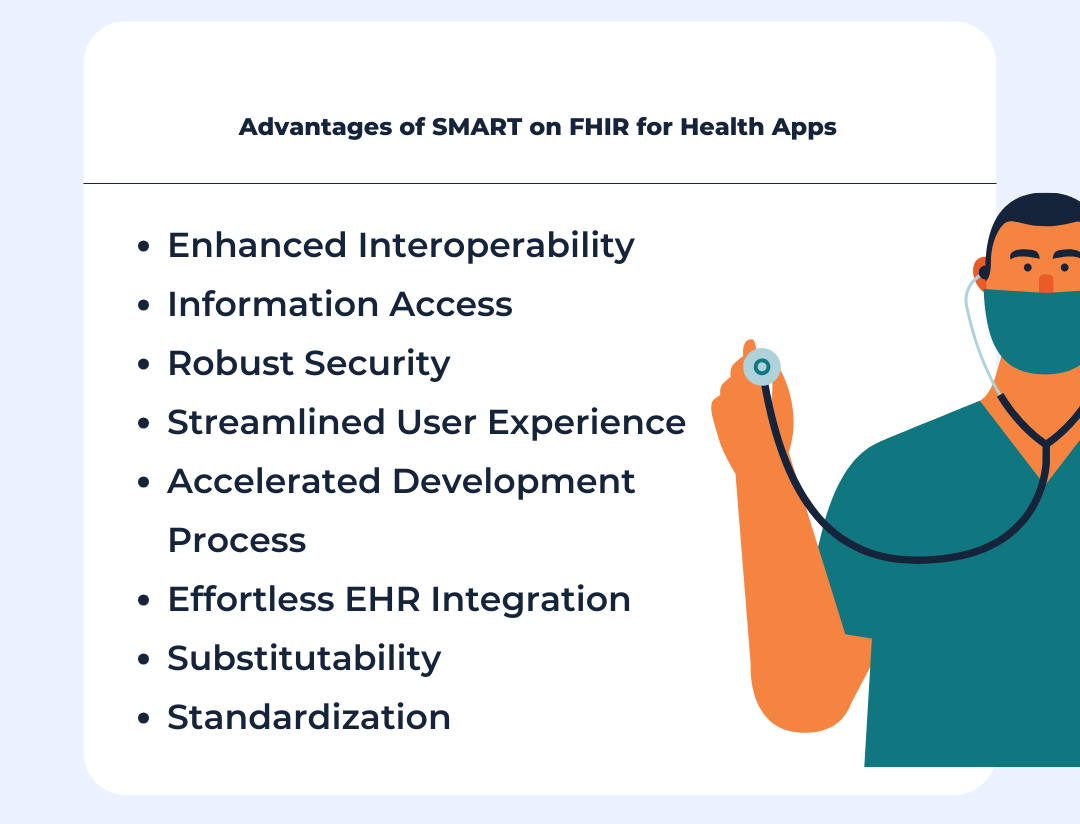
Let’s look at some of the key benefits of SMART on FHIR.
Enhanced Interoperability
SMART on FHIR ensures seamless integration between health apps and multiple EHR systems. This promotes a more open healthcare setting where data flows freely, allowing for a more holistic view of patient care.
Information Access
SMART simplifies how authorized applications access patient data, making retrieving and using health information easy. This enhances decision-making and patient management. On the other hand, it fosters flexible access to health data, empowering developers to create innovative healthcare apps.
Robust Security
Patient data protection is a high consideration for health applications. SMART on FHIR uses strong security protocols such as OAuth 2.0. This reduces security vulnerabilities while ensuring safe and authorized access to patient data.
Streamlined User Experience
The framework enhances health app development by ensuring a consistent user interface (UI). It integrates seamlessly with existing EHR, simplifying development and providing users with an intuitive and familiar experience.
Accelerated Development Process
SMART on FHIR reduces the time and costs associated with building healthcare apps. Development is faster and more cost-effective, as developers can reuse code and functionalities across different platforms.
Effortless EHR Integration
SMART on FHIR integration is seamless across EHR systems. It solves the typical problems with EHR integrations, enabling the creation of applications that expand and improve EHR capabilities.
Substitutability
It supports the development of substitutable apps. This means that outdated programs in systems can be replaced without data or performance issues.
Standardization
SMART on FHIR promotes a standardized approach to healthcare app development. This fosters the creation of a wider array of secure and interoperable applications, empowering patients and providers with more choices for managing and delivering care.
Features of Developing Health Applications with SMART on FHIR

There are numerous features to expect when you develop health applications with SMART on FHIR. Here are some of them.
Integration with EHR Systems
A key feature of SMART on FHIR is the seamless integration of health apps and electronic health record (EHR) systems. This helps healthcare practitioners have a more streamlined and efficient workflow, decreasing complexity and improving data accessibility.
Secure Data Sharing
SMART on FHIR boasts strong security features. The synergy between SMART and FHIR is intended to enable healthcare practitioners to communicate information reliably while adhering to regulatory requirements such as HIPAA.
Improved Interoperability with Various EHR/EMR Systems
Interoperability across various EHR and electronic medical record (EMR) systems is a key feature of SMART on FHIR apps. These apps provide a seamless healthcare experience.
Single Sign-on Functionality
SMART on FHIR allows a single sign-on. Users may easily switch between health applications in the same ecosystem, eliminating the need for several passwords and simplifying the user experience.
Streamlined Workflows
SMART on FHIR apps are designed to speed up workflows, eliminate the need to switch between several systems, and decrease administrative workload. This enables healthcare practitioners to provide more efficient and coordinated care, prioritizing patient attention over repetitive, tedious tasks.
Easy Integration with Other Clinical Software
Easy integration with 3rd-party clinical software is made possible thanks to the SMART on FHIR API. The result is a complete and integrated healthcare environment, which increases the usability of SMART on FHIR apps.
Future-Proofing
Apps built with SMART on FHIR are future-proof. As technology evolves, new functionality or applications can be easily integrated, delivering a flexible and adaptable healthcare ecosystem.
Cloud Services for Hosting
Applications developed on FHIR with SMART can be easily hosted on the cloud. This means scalability, high availability, and low maintenance for healthcare providers, freeing them up to concentrate on providing treatment rather than maintaining IT infrastructure.
Essential Features of SMART on FHIR Applications

Here’s a closer look at the kinds of things SMART on FHIR apps can be designed to do!
Enhanced Collaboration
Applications built using SMART on FHIR are safe platforms for sharing patient data among healthcare practitioners. Real-time access to detailed medical histories, diagnoses, and treatment plans promotes collaboration among doctors, nurses, and specialists.
Streamlined Clinical Research
These applications play an important role in simplifying clinical studies. They make data collecting easier by allowing researchers to get patient data directly from EHRs. They also allow for the enrollment of patients based on certain demographics or medical issues, as well as real-time data collection to monitor trial progress.
Data Interpretation
SMART on FHIR apps provides powerful data analytics features for interpreting medical data from labs, imaging, medication, etc. These apps convert complicated data into easy-to-understand visuals, delivering greater insights into patient care methods and outcomes.
Chronic Disease Management
Patients with chronic diseases can take charge of their own care by using health applications developed with SMART on FHIR. They can monitor their vital signs, receive prescription reminders, access learning resources, and establish connections with online support networks. All of these promote self-management and better health outcomes.
Improved Medication Management
SMART on FHIR apps helps patients stick to their medication schedules by offering refill reminders, identifying potential drug interactions, and tracking whether they take their medications as prescribed. This leads to better patient outcomes and lowers healthcare costs related to missed doses.
Virtual Care Platforms
These apps provide telehealth features. They deliver secure communication channels for video consultations, remote monitoring, and patient education. This improves access to care, especially in remote areas, while ensuring patient privacy.
Health Trend Analysis
Applications built using SMART on FHIR can analyze patient health data to identify trends and potential issues. This enables early detection and intervention, allowing proactive measures to prevent complications and improve patient well-being.
Disease Risk Estimation
These apps can examine medical history, genetic data, and other pertinent information to predict the chance of developing certain health issues—diabetes, cancer, and heart disease. This information will determine the type of preventive measures to take to avoid future health concerns.
Access to Health Documentation
SMART on FHIR applications lets patients access and manage their health and vaccination records quickly. These applications enable patients to manage their health records more effectively, particularly for visa and travel needs.
Security, Compliance & Privacy in SMART on FHIR Development
When organizations develop SMART on FHIR applications, they must uphold the highest standards of privacy and compliance. Handling medical data involves complying with stringent regulations, including HIPAA, GDPR, and various national health privacy laws.
Data Access & Consent Management
A core advantage of the SMART on FHIR architecture is the OAuth2-based authorization protocol, which allows users to authenticate and authorize third-party access securely. Apps request only the permissions they need — ensuring minimal data exposure. Consent management features also allow patients to revoke or limit access at any time.
Encryption & Secure Transmission
All communication between SMART on FHIR apps and EHRs must use encrypted HTTPS channels. Developers are encouraged to implement token expiration policies, IP whitelisting, and certificate pinning to mitigate cybersecurity risks.
HIPAA Compliance and Auditability
Every access event — whether it’s a data retrieval or modification — should be logged and auditable. Maintaining audit trails ensures accountability and simplifies compliance validation. Partnering with experienced smart on fhir developers ensures that applications meet these standards without compromising usability.
Data Storage Policies
Whenever possible, apps should avoid storing sensitive patient data locally. Instead, data should be retrieved dynamically via secure API calls, reducing the risk of unauthorized access. For offline functionality, data must be encrypted at rest with secure key management policies.
Security in SMART on FHIR isn’t just about preventing breaches — it’s about maintaining patient trust. By following SMART on FHIR principles around transparency, consent, and control, developers can deliver solutions that meet both clinical and ethical standards.
Common Challenges in SMART on FHIR Development
Despite the numerous advantages of SMART on FHIR for healthcare app development, significant hurdles exist. Some of these challenges are:
Skills Gap
Developing these applications requires specialized knowledge of FHIR frameworks and healthcare. However, there aren’t enough competent developers with this kind of knowledge.
Limited EHR Support
Not all EHR vendors completely support SMART’s FHIR interface. This limits access to the testing environments and technical requirements for successful app integration.
Inadequate Resources
Building and maintaining these apps can be resource-intensive. It might be difficult for start-ups and small teams to get finance and technological infrastructure.
Data Privacy Concerns
Strict regulations like HIPAA require robust security measures to protect sensitive patient data. This adds extra complexity to app development and deployment.
Reluctance to Change
The sector is sometimes slow to implement new technology. Operators worry about how it will affect workflows and compatibility with existing systems. This may prevent SMART from being widely used on FHIR apps.
Interoperability Limitations
FHIR’s goal is standardized data communication. However, differences in data formats and procedures among EHR vendors still exist, impacting data exchange between applications and systems.
These challenges highlight the importance of teaming up with seasoned experts in this field.
Unlock the benefits of SMART on FHIR integration with Langate’s healthcare development team.
Get in touch today.Key Steps in SMART on FHIR App Development Process
Are you ready to get started with SMART on FHIR development? Let’s look at the steps you’ll likely take.
Choose the Type of App
Begin with a clear goal for your healthcare app.
- What precise problem does it address?
- Who is your target audience (providers, patients, or both)?
- What is the optimal distribution platform (mobile app, web app, or integrating with existing software)?
Clearly defining the app’s purpose will guide the development process.
Implement Security
Security is critical when it comes to sensitive healthcare data. Implement the OAuth 2.0 and OpenID Connect protocols to guarantee that only authorized users can access patient data.
Build the Features
It is now time to start creating the features. Depending on the app’s purpose, this might mean UI/UX design and prototyping, connecting to FHIR APIs to retrieve and analyze patient data, and implementing algorithms or data analysis services.
Test Using SMART Sandboxes
Before you release your software, make sure it is well-tested. Use SMART on FHIR or vendor-specific sandboxes to test functionality and guarantee seamless EHR data integration. This ensures that the software works as intended.
Deploy and Add to App Galleries
After successful testing, deploy your app to a production environment, following EHR vendor compatibility guidelines. To increase visibility and adoption, submit your app to relevant healthcare app galleries, making it easily discoverable by providers and patients.
Ready to build a SMART on FHIR healthcare app?
Learn more!SMART on FHIR vs Traditional EHR Integration: Key Differences
While FHIR and SMART on FHIR play important roles in healthcare IT, they serve different purposes. Here’s how they differ.
FHIR
FHIR establishes a universal language for healthcare data. It defines how clinical elements — drugs, diagnoses, and test results should be organized and shared. This standardization enables the smooth interchange of electronic health records (EHRs) across several systems, eliminating data silos.
SMART on FHIR
SMART on FHIR extends FHIR by enabling secure app development within EHR systems. It offers several advantages over FHIR alone:
- Secure Access and Authorization. Implements strict protocols to ensure that only approved apps can access patient data in EHRs, focusing on patient privacy and data security.
- Streamlined UI Integration. This integration integrates multiple healthcare apps into the existing EHR interface, simplifying navigation and workflow for clinicians and eliminating the need for separate logins and interfaces.
Choosing between FHIR and SMART on FHIR depends on the developers’ goals and the healthcare app’s requirements:
- FHIR. Ideal for achieving interoperability and standardizing data exchange across healthcare systems, making integration and data sharing easier.
- SMART on FHIR. Preferable for creating secure, interoperable healthcare applications that connect smoothly with EHRs while improving user experience and data access control.
In healthcare app development, combining both standards yields the best complete solution where efficiency, interoperability, and patient-centered care are prioritized.
Successful Examples of SMART on FHIR Applications
This section looks at three successful examples of SMART on FHIR applications demonstrating the technology’s potential to change healthcare delivery.
Apple Health Records
Apple uses SMART on FHIR to link its Health App with various EHR vendors. This enables users to securely exchange their health information with doctors and other healthcare professionals at partner U.S. healthcare institutions. For example, a diabetic patient can easily readily share their blood sugar data with their doctor via the Health App, easing communication and perhaps enhancing diabetes care.
Precision Cancer Medicine Apps
SMART on FHIR powers the SMART Precision Cancer Medicine app developed by Vanderbilt-Ingram Cancer Center. This tool helps doctors by displaying patients’ specific cancer genomic information in the EHR. Based on a patient’s genetic composition, this focused approach can influence treatment decisions and lead to more tailored and successful cancer therapy.
SMART Cardiac Risk app
The SMART Cardiac Risk app, developed by Boston Children’s Hospital, uses SMART on FHIR to make cardiovascular risk assessment more accessible using the Reynolds Risk Score. The beauty lies in allowing patients to see how their cancer risk score changes based on modifiable factors, potentially motivating lifestyle changes.
How Langate Supports Healthcare Providers with SMART on FHIR Development
To develop a healthcare application using SMART on FHIR, you need a company with hands-on expertise and relevant certifications. Langate has it all.
With over twenty years of experience offering custom healthcare software development services, Langate brings knowledge and proven expertise to every project. Our track record includes successful SMART on FHIR integrations with Cerner, as well as equally helpful integrations with Epic and Allscripts, all leading EHR vendors. This deep familiarity allows us to build and seamlessly connect your application with popular EHR platforms, ensuring smooth data exchange and interoperability.
This expertise enables us to develop custom features that enhance your software’s functionality while ensuring that your SMART on FHIR app complies with industry standards and is optimized for performance and usability.
To expedite development, Langate offers pre-built SMART on FHIR modules. These modules facilitate integration with popular EHR vendors, reducing development time and costs.
By leveraging FHIR app development standards combined with SMART’s security layer, Langate builds scalable healthcare apps that enhance both patient experience and clinical workflows.
Contact us today!
Conclusion: Why SMART on FHIR is the Future of Healthcare Apps
SMART on FHIR offers a transformative approach to healthcare app development. By leveraging standardized data (FHIR) and secure application integration (SMART on FHIR), developers can create innovative applications that seamlessly integrate with existing workflows.
This fosters a more open, interoperable healthcare ecosystem, empowering providers with efficient tools and patients with greater control over their health data. As healthcare continues to evolve, SMART on FHIR stands poised to play a pivotal role in building a future of efficient, patient-centered care.


