

One of the first questions founders and product leaders ask is how long it takes to develop an app. The honest answer is: it depends. App development timelines differ considerably according to complexity, platform, regulatory requirements, and the maturity of your product idea.
In this guide, we will look at how long it takes to develop an app depending on the type of app. We will explain the stages of app development.
Many things can affect how quickly an app is developed. We will discuss these. We will also share a real-life example from Langate about how long it took to develop an app and what results they got.
If you are getting ready to launch an app and want to know what to expect, this article is for you. It will help you understand the app development process and timeline.
Typical App Development Timelines by Type
Simple apps (2–4 months)

Simple apps (2–4 months)
Simple apps focus on a limited feature set and simple user flows. Typical examples include:
- MVPs and proof-of-concept apps
- Internal tools
- Single-purpose consumer apps
Typical scope
- One platform (iOS or Android)
- Basic UI
- Minimal backend logic
- Limited integrations
Timeline breakdown
- Discovery & design: 2–3 weeks
- Development: 6–10 weeks
- Testing & launch: 2–3 weeks
If you’re wondering how long it takes to build an app with only essential functionality, this is the fastest path to market. It’s also the most common approach for startups that want to validate an idea before committing to an entire build.
Medium-complexity apps (4–7 months)

Medium-complexity products combine richer user experiences with more advanced backend logic.
Typical scope
- iOS and Android (often cross-platform)
- User authentication and roles
- APIs and third-party integrations
- Analytics and notifications
Timeline breakdown
- Discovery & UX/UI: 3–5 weeks
- Development: 3–4 months
- QA, iteration, release: 4–6 weeks
This is where most teams start asking how long it takes to make an app that’s actually scalable and market-ready — not just a throwaway prototype.
Complex / enterprise / regulated-industry apps (6–12+ months)

Enterprise-grade applications require deeper architecture, higher security standards, and conformity with regulations.
Typical scope
- Multi-platform support
- Complex business logic
- Advanced integrations
- Security, audits, and compliance (HIPAA, GDPR, SOC 2)
Timeline breakdown
- Discovery & architecture: 1–2 months
- Development: 4–8 months
- Compliance, testing, rollout: 2–4 months
In regulated environments, how long app development takes is mainly influenced by compliance reviews and validation cycles — not just engineering. Healthcare and fintech apps almost always land in this category.
Key Phases of App Development
Regardless of size, every mobile app development timeline runs through the same core phases:
Discovery & Planning Requirements, risks, architecture, roadmap.
UI/UX Design Wireframes, user journeys, interactive prototypes. Learn more about our UI and UX design services.
Development Frontend, backend, integrations, and infrastructure.
Quality Assurance Functional, performance, and security testing.
Launch & Post-Launch Support App store submission, monitoring, optimization.
Skipping or rushing any of these phases almost always creates rework down the line — and ironically makes the total app development time longer, not shorter.
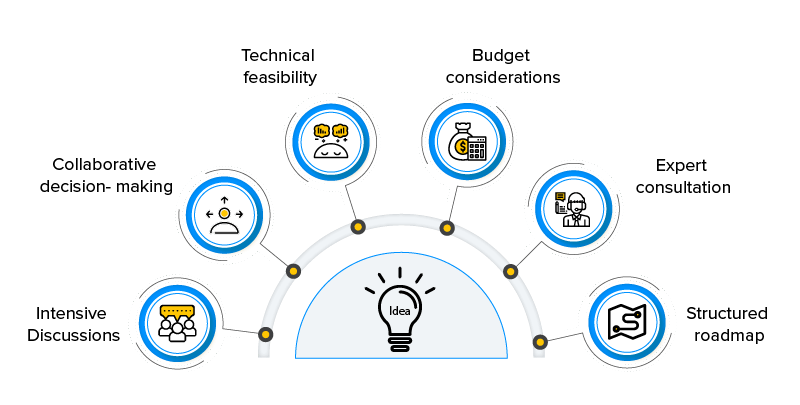
Factors That Influence the Timeline
Several variables directly shape the schedule for app development:
- Scope clarity: Vague or shifting requirements are the single biggest driver of delays.
- Platform strategy: Native vs. cross-platform carries real trade-offs in time and cost.
- Regulatory requirements: Healthcare and finance add meaningful time — no way around it.
- Third-party integrations: APIs, legacy systems, and data providers each introduce dependencies.
- Team experience: Teams that have built similar products before move faster and make fewer expensive mistakes.
The more regulated the industry, the longer the app development timeline — even when you’re working with an experienced partner.
Case Study Spotlight
Transforming Healthcare Data Validation with a Cross-Platform Mobile Solution
What we started with
A healthcare client operating in long-term care had been relying on an outdated web portal. Mobile usability was poor, workflows were cumbersome, and staff struggled to complete insurance eligibility checks in the field.
What we did
Langate delivered a cross-platform healthcare app built in Flutter:
- Complete UI/UX redesign
- Mobile-first data validation workflows
- Backend rewrite and optimization
- HIPAA-compliant architecture
- Effortless integration with the existing web portal
Project scope
- Duration: 6 months
- Team: 2 developers, tech lead, QA, BA, PM
- Platforms: iOS & Android
Results in numbers
- 50% speedier data validation workflows
- Significant reduction in user errors during eligibility checks
- Full HIPAA compliance across mobile and web
This project is a useful reference point for anyone asking how long it takes to develop a mobile app in a regulated industry. With the right process and team structure, complex doesn’t have to mean unpredictable. Learn more about our healthcare app development expertise.
Ready to estimate your app timeline?
Talk to us.How to Accelerate Your App Launch
If speed matters — and it usually does — here are proven ways to shorten your app development time without sacrificing quality:
- Start with an MVP. Read our guide on MVP development.
- Use cross-platform frameworks when appropriate.
- Validate requirements early with prototypes.
- Automate testing and CI/CD.
- Work with a team experienced in your industry.
Going faster isn’t about cutting corners. It’s about making better decisions earlier, so you’re not fixing avoidable problems later.
Why Choose Us to Develop Your App on Time
Langate combines deep engineering expertise with sector-specific delivery models. As a long-term technology partner, we help clients:
- Set realistic timelines that they can actually plan around
- Avoid the rework cycles that quietly double project costs
- Meet regulatory and security requirements without turning compliance into an eleventh-hour rush
Our custom application development services are built to keep projects predictable, transparent, and on schedule — from kickoff to launch.
Final Thoughts
So, how long does it take to develop a mobile app — or any app for that matter? For most products, you’re looking at somewhere between 2 and 12 months. The right answer depends on what you’re building, what industry you’re in, and what you want the product to do long-term.
What we’ve found after working with clients throughout healthcare, finance, and enterprise software is that the teams who invest time upfront in planning and clear requirements consistently ship faster than those who rush into development. If you’re trying to figure out your app development timeline, that’s usually the best place to start.


