

The healthcare sector is undergoing significant digital changes, with electronic medical records leading the way. These digital records have become increasingly important, highlighted by their market’s projected growth to $47.60 billion by 2030.
EMRs offer numerous advantages. They guarantee that patient data is accurate and thorough, streamline healthcare operations, reduce expenses, and enhance patient care. However, integrating EMRs into healthcare systems poses challenges. Specialized knowledge is needed to ensure that these systems can seamlessly interoperate and adhere to all regulatory requirements.
This guide will uncover more benefits and challenges of EMR/ EHR integration and how to select the right integration partner. Continue reading to learn more.
What is EMR integration?
Electronic Medical Record (EMR) integration is the process of seamlessly incorporating digital health records into healthcare workflows and systems. The goal is to unify all patient health data in one digital place. EMR integration helps healthcare providers easily see a patient’s health for better care coordination and decision-making, which results in improved patient outcomes.
EMR usage in healthcare has surged, with around 88.2% of office-based doctors using some EMR/EHR system by 2021.
Importance of EMR Integration in Healthcare Settings
The importance of EMR integrations in healthcare cannot be overemphasized. This integration revolutionizes healthcare data management by replacing paper charts with a streamlined digital storage system. This eliminates the need for laborious sorting through medical charts, saving healthcare providers valuable time and effort.
Moreover, digital storage enhances data accessibility, facilitating efficient analysis and informed decision-making. When done correctly, EMRs optimize workflow and promote collaboration among healthcare teams, ultimately enhancing patient care, safety, and relevant regulatory compliance.
Integration Use Cases by Healthcare Sector
The impact of EMR connectivity extends far beyond patient records. Each healthcare sector applies electronic medical records integration differently, depending on workflows, data volume, and patient interaction models.
1. Hospitals and Health Systems
Hospitals rely on integrated EMR systems to unify departments, from emergency and radiology to billing and pharmacy. Integration enables real-time updates to treatment plans, better coordination between physicians, and fewer errors in patient transfers. For example, automated device integration in EMR allows vital signs, lab results, and imaging data to flow seamlessly into the patient chart without manual entry.
2. Ambulatory and Outpatient Clinics
Smaller practices benefit from simplified data exchange with laboratories, pharmacies, and insurance systems. Streamlined EMR lab integration supports automated test result retrieval and physician notifications, improving patient turnaround times.
3. Telehealth Providers
For telemedicine platforms, electronic medical record integration ensures that virtual consultations feed directly into patient histories. This maintains continuity of care, especially when multiple providers are involved across different care settings.
4. Diagnostic and Imaging Centers
Diagnostic facilities use EMR integration tools to upload radiology or pathology results instantly. These integrations help prevent reporting delays and reduce administrative load by connecting imaging software to hospital EMR systems.
5. Pharmacies and Long-Term Care Facilities
Integrating EMR systems with dispensing platforms and medication management solutions ensures medication safety and regulatory compliance. Automation reduces transcription errors, enhances traceability, and supports clinical decision-making.
Whether for a hospital or an outpatient clinic, the EMR systems experience is vastly improved when data flows seamlessly across all endpoints of patient care.
EMR Integration and Data Standards You Should Know
Understanding EMR integration standards is essential to building sustainable and interoperable healthcare systems. Compliance with recognized protocols ensures data integrity, compatibility, and long-term scalability.
Key Data Standards
- HL7 (Health Level 7)
The foundation of EMR communication, HL7 governs how information is structured and shared between systems. - FHIR (Fast Healthcare Interoperability Resources)
The modern, web-friendly version of HL7 supports RESTful APIs and JSON or XML formats. FHIR enables rapid integration and is the core standard behind many modern EMR APIs. - DICOM (Digital Imaging and Communications in Medicine)
A specialized standard for medical imaging, ensuring interoperability across radiology and imaging platforms. - LOINC and SNOMED CT
Used for laboratory and clinical terminology coding, ensuring uniform understanding of diagnostic and treatment data.
Compliance and Interoperability
When defining your EMR integration meaning, it’s crucial to build on standards that ensure interoperability, not just internal connectivity. A robust integration architecture enables easy upgrades, vendor transitions, and the flexibility to add new data endpoints.
Choosing a provider or development partner experienced in electronic medical records integration and EMR connectivity guarantees that your system remains compliant and compatible as regulations evolve.
Benefits of EMR Integration
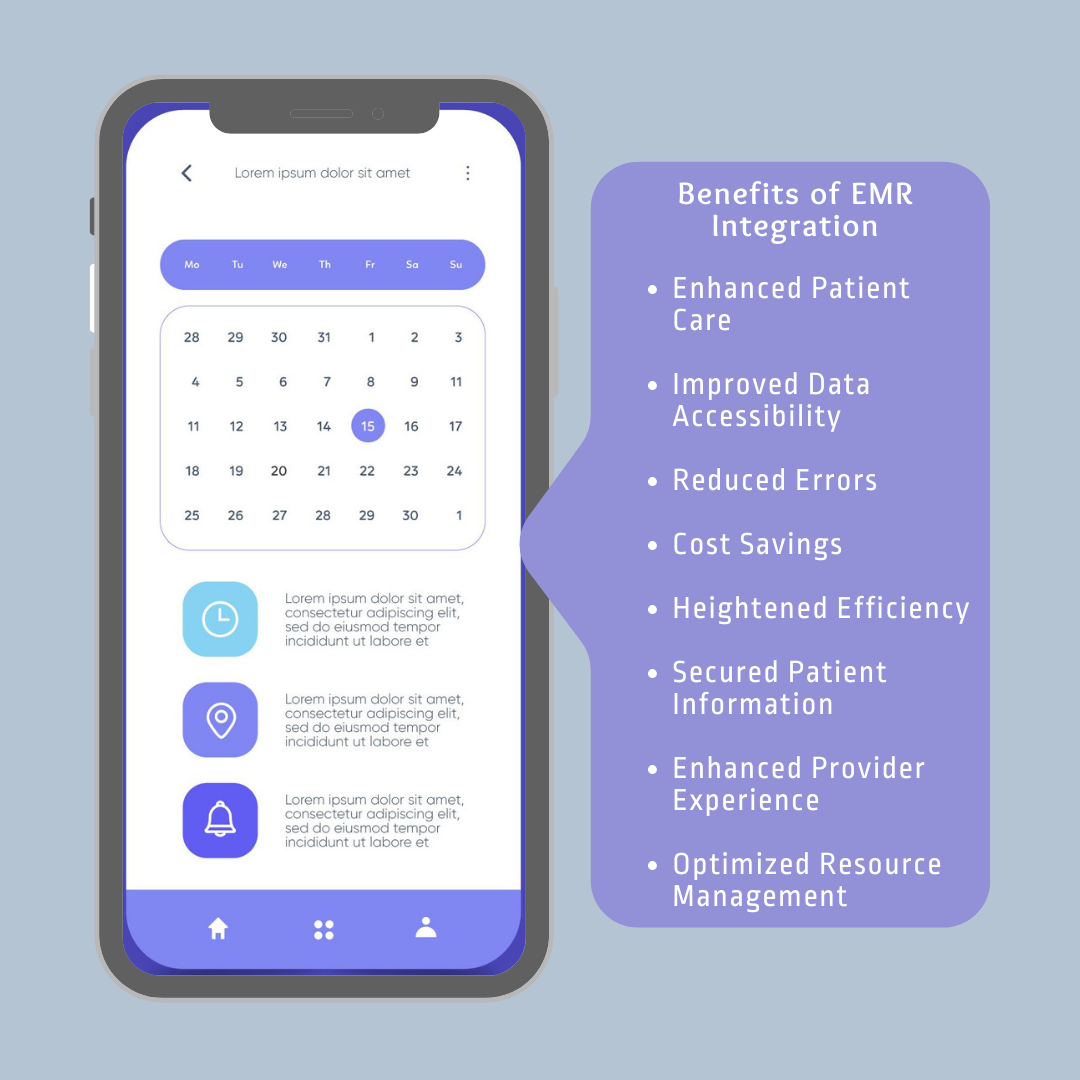
Let’s dive into why investing in EMR integration software can be a game-changer for healthcare organizations.
Enhanced Patient Care
EMR system integration centralizes patient data and grants healthcare providers swift access to comprehensive medical records. This eliminates the need for manual searches through paper files or solely relying on memory. EMRs allow doctors to make well-informed decisions based on precise information, leading to improved diagnoses and personalized treatment strategies.
Improved Data Accessibility
With EMR data integration, healthcare providers can retrieve patient data from anywhere with an internet connection. This seamless flow of information ensures that all involved parties have the necessary details for coordinated and effective care delivery.
Reduced Errors
Manual data entry and reliance on paper records often lead to inaccuracies. Integration with EMR automates data transfers, enhancing precision levels and ensuring patient safety.
Cost Savings
Integrating EMR systems saves costs by minimizing manual input requirements, paper documentation burdens, and storage demands. Interoperability between systems further reduces expenses by eliminating duplicate tests or procedures.
Heightened Efficiency
Transitioning to digital technologies eliminates the time-consuming task of handling physical paperwork. Healthcare practitioners can spend more time on patient care rather than administrative activities. Furthermore, EMR integration reduces the need for unnecessary document cross-checks, saving time and costs for everybody concerned.
Secured Patient Information
Breaches or unauthorized access to records can harm patient privacy and result in legal issues. EMR systems use strong security measures like encryption and user authentication to safeguard data. This helps meet relevant compliance like HIPAA and builds trust between patients and healthcare providers.
Enhanced Provider Experience
Integrating EMRs boosts the provider’s experience by making things smoother. Easy access to patient records, simpler charting, and automatic drug interactions or allergy alerts make the workflow more efficient and satisfying for healthcare pros. This means happier staff and lower burnout rates. With EMR integration, providers can concentrate on patient care instead of paperwork, making healthcare careers more rewarding.
Optimized Resource Management
The shift towards digital platforms reduces the demand for physical storage space while mitigating risks associated with lost or damaged records. Additionally, EMRs streamline billing processes and insurance claims by reducing paperwork errors – ultimately enhancing financial stability.
Challenges in EMR Integration

Like any digital transformation project, integration with EMR has its share of challenges. Here are the top ones.
Interoperability Challenges
Interoperability poses a significant hurdle in EMR data integration. Healthcare setups use different software that can’t talk to each other. This gap makes it hard to share patient data smoothly, leading to fragmented records. Consequently, healthcare providers face difficulty accessing a complete medical history, impacting the quality of care they can offer.
Cost of Integration
The cost of EMR integration can be quite hefty. The expenses add up quickly, from installing software to upgrading hardware and training staff. Pricing models like subscription-based or pay-per-visit, along with deployment options (on-premise or cloud-based), impact costs. Customization and data migration also contribute. This financial hurdle can discourage healthcare providers from adopting EMRs, creating a barrier to entry.
Security Compliance Issues
Ensuring security compliance is one of the major EMR integration challenges. Patient data stored and transmitted electronically must be safeguarded. Healthcare facilities must adhere to strict regulations like HIPAA in the USA, PHIPA in Canada, and the Data Protection Act of the UK’s NHS. These regulations ensure patient information protection. Failure to comply can lead to serious legal and reputational repercussions for providers.
Technical Limitation
EMR systems are intricate, covering different functions like patient records, scheduling, billing, and reporting. Integrating these modules smoothly, ensuring compatibility and data integrity, is technically demanding. Also, transitioning from paper-based to digital EMRs requires staff to gain new technical skills. Insufficient training can cause inefficiencies, errors, and user frustration.
Resistance to Change
Resistance to change is a major hurdle for healthcare providers in EMR integration. Clinicians and staff might hesitate due to unfamiliarity, fear of disrupting routines, and worries about extra administrative work. Around 70% of change programs fail due to such resistance and lack of support. Overcoming this needs robust change management: thorough training, ongoing education, and clear communication. Engaging key stakeholders is vital for successful integration.
Leadership Buy-in
Administrative conflict and leadership buy-in are pivotal for the success of electronic medical records integration. Resistance or lack of support from senior management and department heads can impede EMR adoption. Securing leadership buy-in is vital to navigating organizational change and addressing any conflicts that arise during integration.
Seamlessly integrate EMR/EHR into your healthcare workflow with Langate.
Learn more.Key Components of EMR Integration
Integrating Electronic Medical Records (EMR) brings a host of powerful components that enhance efficiency and patient care. Here are the key ones.
Analytics, Dashboards, And Reports
Monitoring performance is easy with analytics, dashboards, and reports. Analytics is a core component of an EMR and provides valuable insights into crucial metrics, patient outcomes, and areas that could use enhancements, empowering well-informed decisions.
Monitoring performance is easy with analytics, dashboards, and reports. Analytics is a core component of an EMR and provides valuable insights into crucial metrics, patient outcomes, and areas that could use enhancements, empowering well-informed decisions.
Patient Records
Digital patient records are easier to manage and retrieve. They offer accuracy, real-time updates, and quick retrieval over traditional paper-based data. This guarantees that medical professionals always have access to critical patient data, improving the standard and promptness of service.
Clinical Workflows
Automate clinical tasks such as appointment scheduling, integrating lab results, and managing medications. This component helps to save time, reduce errors, and boost productivity. Streamlining workflows through EMR integration gives healthcare professionals more precious time to dedicate to patient care.
Collaborative Tools
This integration provides instant messaging, file sharing, and task assignment tools for improving collaboration in healthcare. It fosters teamwork and ensures everyone is aligned for optimal patient outcomes.
E-Prescriptions
Bid farewell to traditional paper prescriptions as EMR enables electronic prescription writing and transmission for improved medication prescription accuracy while streamlining pharmacy processes.
Order Management
Automate the order process from start to finish. This component handles verification procedures, pharmacy communications, as well as inventory tracking. It helps to reduce administrative workload, ensuring timely delivery of essential supplies and medicines.
Billing and Coding
Simplify billing coding procedures for precise capture of patient data. This essential component means improved revenue, better cycle management, and reduced errors while maintaining compliance with billing regulations. It helps healthcare practices stay financially sound while effectively meeting industry standards.
Electronic Progress Notes
Digitally document progress notes for easy retrieval, sharing, and storage. This core component of integrated EMR fosters continuity of care and communication among healthcare providers and facilitates a seamless transition between different caregivers while ensuring comprehensive patient history is maintained.
Essential Medical Device Integration with EMR
Integrating electronic medical records (EMR) with various systems is vital for boosting efficiency and elevating patient care. Let’s explore some key integrations:
Telehealth Integration
Integrating EMR with telehealth technologies allows healthcare practitioners to readily access patient records, conduct virtual consultations, and rapidly communicate information. This makes remote healthcare more accessible. At least 80% of individuals have utilized telemedicine at some point, demonstrating its importance to the future of medicine.
Laboratory Information System
Connecting EMR systems to laboratory information systems is critical for the efficient and exact administration of lab data. Healthcare practitioners can quickly obtain patient test results, examine lab data, and combine it with the patient’s medical information. The LIS industry is expected to reach $6.36 billion by 2029, highlighting its importance for healthcare practitioners.
Clinical Trial Management System
Linking an EMR to a Clinical Trial Management System (CTMS) streamlines clinical trial management. This connection makes it easy to track patient progress, create trial schedules, and rapidly evaluate trial data. As more healthcare providers embrace CTMS, the market is predicted to increase by 11.4% by 2030.
Medical Device Integration (MDI)
By linking electronic medical records with medical devices, healthcare providers can gather live data, monitor patient well-being, and seamlessly incorporate it into patient records. This streamlines device handling enhances patient treatment, and ensures smooth data flow.
About 33% of Americans use wearable medical gadgets to monitor their health. More than 80% share the data from these devices with their doctors, highlighting the importance of seamlessly integrating the data generated by these devices into hospital or clinic information systems.
Medical Billing
Electronic medical records (EMR) linked to the health care facility’s medical billing systems smoothen the management of the facility’s finances. This, in turn, assists hospitals and health systems in reducing the processing time for claims, tracking payments, and verifying associated billing data. This helps create increased cash flow, fewer errors, and accurate billing. Many hospitals have adopted this approach, with 74% using some form of revenue cycle automation.
Discover the power of seamless healthcare software integration for enhanced efficiency and superior patient care.
Contact Langate today!Questions to Ask Before Starting an EMR Integration Project
Before starting any integration initiative, it’s critical to clarify your technical and operational expectations. Here are key questions that every organization should answer before developing or upgrading an EMR system.
- What’s the goal of integration?
Define whether the aim is to connect new apps, automate workflows, or enhance analytics. The clearer the objective, the smoother the process. - Which systems need to communicate?
Identify all participating systems, including EMR, billing, labs, wearables, and telehealth platforms. Mapping them early reduces scope creep. - What standards will we use?
Ensure alignment with HL7, FHIR, and DICOM to future-proof the integration. If you use third-party APIs, verify their compliance with EMR integration standards. - How will data security be handled?
Confirm encryption methods, role-based access, and audit logging. Ask vendors how they maintain compliance with HIPAA and GDPR. - Who manages support and updates?
Maintenance after deployment is as essential as initial setup. Define accountability for updates, version control, and integration support. - How will you test before going live?
Plan staged rollouts with test environments for lab systems, third-party APIs, and end-user validation.
Asking these questions upfront prevents costly setbacks and ensures your EMR guide leads to a stable, compliant, and maintainable integration project.
EMR Integration Process
Planning
At Langate, our step-by-step process for EMR integration begins with planning. We assess the current healthcare infrastructure and understand the organization’s needs and goals. We then carefully select the appropriate EMR system that aligns with these requirements. Collaborating with key stakeholders, we create a detailed roadmap for the integration process.
Integration Design
Moving on to integration design, we meticulously map workflows and processes the EMR system affects. Considering factors such as data storage, databases, and exchange standards, we determine how the EMR system will interface with existing systems. We choose the best integration approach, whether common data storage, API integration, or mediated integration, and select a suitable tech stack accordingly.
Build
Then, on to the build stage, where our experienced technical team develops integrations and customizations for the EMR system. This is where coding, data mapping, and interface configuration come in.
Integration Testing
Here, we rigorously test all components to ensure they function correctly and exchange data accurately between systems. We conduct performance and security testing to ensure compliance with privacy and industry standards, resolving any bugs or issues that arise along the way.
Implementation
With successful integration testing completed, the EMR system is ready for implementation. We oversee the migration of existing patient records, provide comprehensive training to healthcare staff on system usage, and facilitate a smooth transition from the old records system.
Support & Scalability
Finally, we offer ongoing support and scalability. Our team provides continuous assistance to troubleshoot any issues with the EMR system and ensures it can scale effectively to accommodate the organization’s growth, handling increased patient volumes and additional functionalities as needed.
How can Langate help you with EMR integration?
According to Harvard Business Review, most digital transformation projects flop, with failure rates ranging from 70% to 95%. While various factors contribute to this, teaming up with a dependable IT partner significantly boosts your chances of success.
If you’re searching for a dependable partner to navigate you through the complexities of EMR system integration, Langate can help. With over 20 years of vertical-specific software development expertise, we can cover every aspect of your EMR integration journey. Our extensive experience enables us to craft custom healthcare solutions tailored precisely to your organization’s requirements, keeping all relevant privacy and health regulations in mind.
With Langate by your side, you can rest assured of receiving expert support throughout the EMR implementation process.
Conclusion
Integrating EMRs is crucial for today’s healthcare practices. It helps to boost efficiency, improve patient care, and streamline operations. However, integration is a complex task needing technical know-how and adherence to regulations. By following the insights and strategies in this guide, healthcare professionals can confidently navigate EMR integrations, ensuring smooth interoperability and reaping maximum benefits from digital health tech.


